The Average Cost of a Panel Upgrade in Orange County in 2026
Most South Orange County homeowners pay around $4,000 to $6,500 for a full 200-amp upgrade that includes the permit, new meter equipment, minor code fixes, and Southern California Edison coordination. The simplest job, a clean like-for-like swap where the panel is already in a good spot and the wiring is sound, can start lower, in the $2,500 to $4,500 range. These are typical 2025 to 2026 ranges drawn from aggregated Southern California contractor pricing, not a formal survey, so treat them as a planning guide.
National calculators show $1,300 to $3,000 for a generic 200-amp swap, and those numbers are real somewhere, just not here. Coastal South OC runs higher because labor rates are up, permitting is stricter, SCE has to coordinate the shutoff, and our older tract homes hide problems behind the wall. Budget toward the top of the band, not the bottom, and you will rarely be surprised.
One thing a panel upgrade does not do is rewire your house. It replaces the service equipment (the box, the meter base, and the wires feeding the home) and not the branch wiring running to your outlets and switches. A true gut rewire is a separate, much larger project that can run $20,000 to $25,000 or more for a roughly 1,500 square foot house, so a few-thousand-dollar quote that calls itself a rewire really means a panel upgrade.
We are The Panel Pros, the panel-only division of All Thingz Electric, serving Aliso Viejo, Laguna Niguel, Mission Viejo, Lake Forest, Dana Point, San Clemente, and the rest of South Orange County. Panels are all we do.
What 100-Amp, 200-Amp, and 400-Amp Upgrades Cost
The bigger the jump in capacity, the more equipment and utility work it takes, so amperage is the single biggest lever on your price. Swapping a panel for the same amperage is far cheaper than actually raising your service, because a real upgrade pulls in a new meter base, new service-entrance cable, a new mast, and SCE scheduling.
| Scope | Typical South OC range (2026) | What's going on |
|---|---|---|
| Like-for-like 100A to 200A swap | ~$2,500 to $4,500 | Best case. Panel is in a good spot, wiring is sound, minimal code corrections. |
| Full all-in 200A upgrade | ~$4,000 to $6,500 | The realistic band for most homeowners. New meter base and service equipment, permit, minor code fixes, SCE coordination. |
| 400A service | ~$6,000 to $12,000+ | Large or luxury homes, all-electric loads, or a house plus an ADU. Heavy-duty gear and specialized breakers. |
Most South OC single-family homes are well served by 200-amp, and bigger is not automatically better. A 400-amp service only makes sense for a very large or fully electric home, or a main house plus an accessory dwelling unit. The NEC optional load method (220.82) gives a 200-amp service real headroom for a heat pump and an EV charger, so paying for capacity you will never use is just spending extra.
Book a free on-site assessment. We give you a straight answer and a flat-rate price in writing, with no obligation.
What's Actually Inside a Panel Upgrade Price
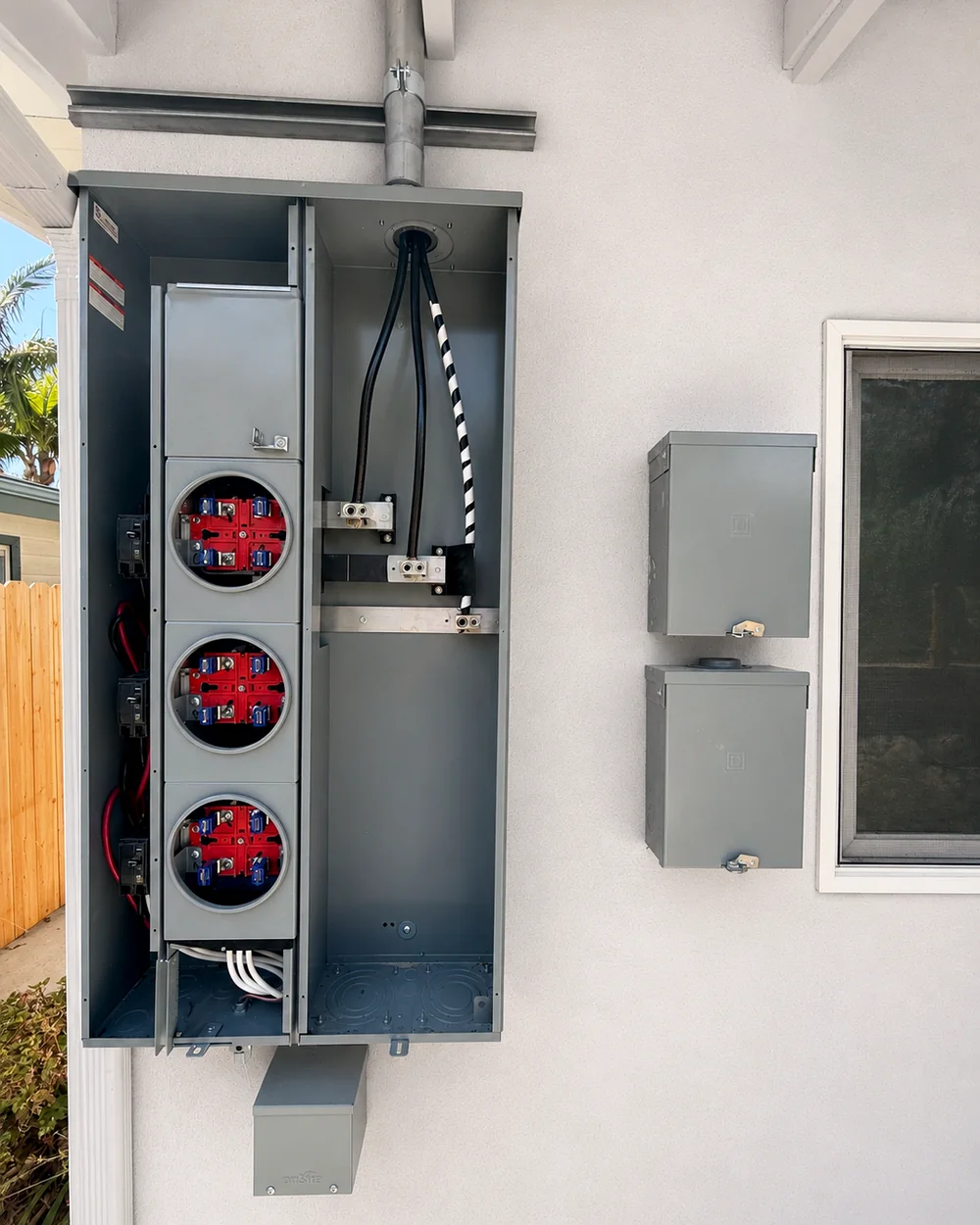
A real quote covers the panel, the meter base, the permit, the SCE coordination, grounding, and labor, and the parts you cannot see are usually where a cheap quote cut corners. Here is what goes into the number, with the jargon translated.
- The panel itself (the breaker box, or load center). Equipment for a 200-amp setup, the breaker panel and breakers, commonly runs a few hundred dollars up to around $1,500 depending on brand and whether you choose a standard or smart panel.
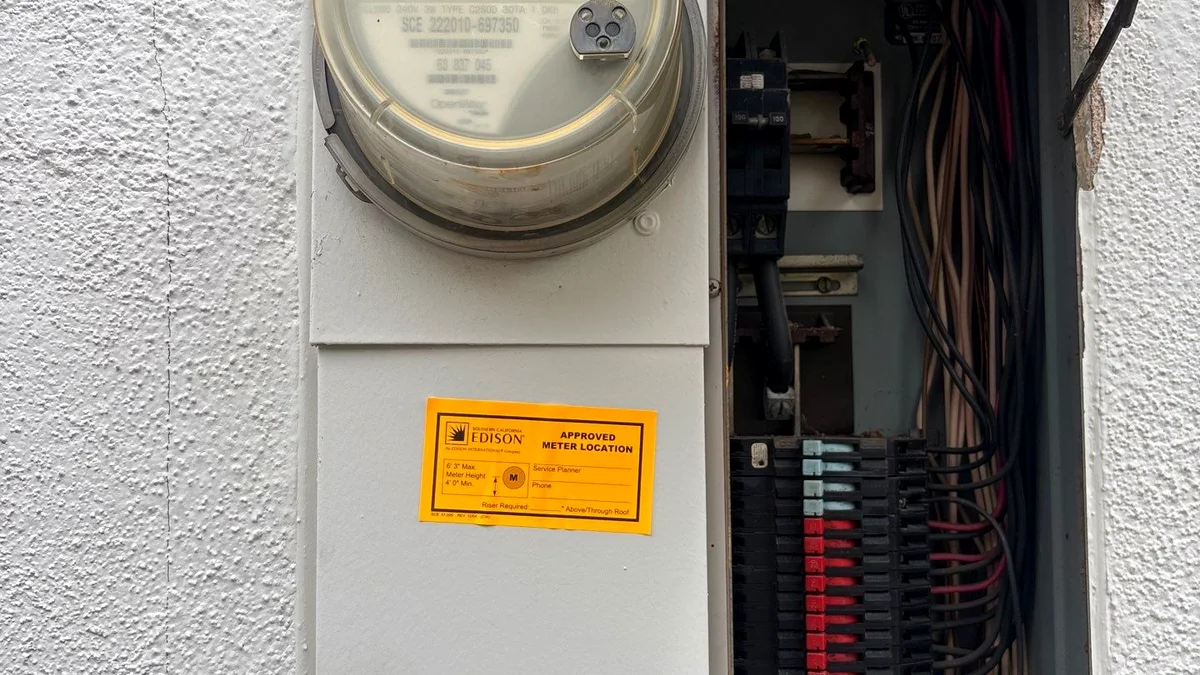
- The meter base (where SCE's meter plugs in). Roughly $200 to $500 for the socket.
- The service mast and riser (the metal pipe and weatherhead carrying the wires up to the utility connection). Materials commonly run $750 to $950 when it must be replaced to meet code.
- Grounding and bonding (the safety path that trips breakers and prevents shock and fire). Often $150 to $350 to bring up to current code.
- The city permit. Typically $100 to $500 and it varies by city, so the exact number gets confirmed with your city's building department.
- SCE disconnect and reconnect coordination (the utility shuts off power so we can work, then re-energizes). Utility-side coordination commonly adds a few hundred dollars and depends on SCE's scheduling.
- Labor. Usually $1,000 to $3,000, and South OC skews to the higher end because this is a high cost of living market.
- Drywall or stucco patch and minor repairs after the work. Often $500 to $2,000 when old wiring or grounding has to be corrected along the way.
A straightforward swap is frequently 4 to 8 hours of work. With extra wiring, a relocation, or heavier coordination, plan for one to two days. We give you all of this as a single flat-rate number in writing before any work starts, so there is no running tab.
Why Two Electricians Quote Wildly Different Prices
Most of the time the quotes are not for the same job, even when they look like they are. If one bid is half the other, the gap almost always comes down to four things.
Scope and hidden conditions
The cheap quote often assumes a clean job. The expensive quote priced in reality. South OC's older homes hide undersized or corroded feeders, missing grounding, and aluminum branch wiring common in 1965 to 1973 builds that needs pigtailing or replacement to be safe. None of that shows from the driveway, so an honest electrician inspects first or warns you the number could move once the cover comes off.
A same-size swap vs a true upgrade
Replacing a panel at the same amperage is a different animal than going 100A to 200A. The real upgrade adds the meter base, the service-entrance cable, the mast, and SCE coordination. Make sure you are comparing the same scope.
Permitted vs unpermitted
A licensed contractor who pulls the permit and coordinates the SCE shutoff and inspection costs more than a handyman doing unpermitted work, and that is the point. Panel work in OC cities legally requires a permit and an inspection. Unpermitted work is dangerous, can void your homeowners insurance, and causes real problems when you sell. The higher number buys code compliance, an inspector's sign-off, and a safe job, not just labor.
Equipment grade
A standard panel and a smart panel are not the same price, and copper feeders cost more than aluminum. New circuits or AFCI and GFCI breakers to bring the home current show up too.
If you want to know whether you even need a bigger service, our guide on whether your older South OC home needs a 200-amp panel walks through the load calculation that actually decides it.
Add-Ons That Push the Price Higher
The base price assumes the panel stays roughly where it is and the surrounding gear is sound, so the add-ons that raise your total are mostly about moving the panel or fixing what is around it. The common ones:
- Panel relocation, moving it from inside to outside or repositioning it, typically adds about $1,000 to $3,000 or more. It means re-routing feeders, a new mast and riser, drywall or stucco patching, and sometimes trenching.
- A new mast or riser when the old pipe and weatherhead no longer meet code.
- Grounding and bonding corrections to bring an older home up to current code.
- A sub-feed or sub-panel, a secondary panel for a garage, an ADU, or an EV circuit, when you need more circuits than the main can hold cleanly.
- Drywall and stucco repair after the electrical work, especially when feeders had to be re-run.
- Corrosion-resistant outdoor enclosures near the coast, which is a real South OC cost driver, not an upsell.
Why coastal and older South OC homes cost more
Two local realities push our jobs toward the upper half of any range. First, salt air. Homes near Laguna Beach and the coastal edges of Mission Viejo and Lake Forest face accelerated corrosion of outdoor meter sockets, panel cans, and lugs. Near the coast we spec corrosion-resistant, NEMA-rated enclosures and sometimes replace pitted gear an inland quote would never include.
Second, the age of the housing stock. A lot of South OC's older inventory still runs obsolete or hazardous panels. Federal Pacific Electric, Zinsco, and Challenger panels from the 1950s through the 1980s are known fire hazards because their breakers can fail to trip on an overload. Many insurers now refuse coverage or require replacement, so some homeowners are not choosing to upgrade so much as being told they have to. We cover that in our guide to Federal Pacific and Zinsco panels and insurance.
Rebates, Tax Credits, and Financing in California
Right now, in mid-2026, there is no clean direct cash rebate for a standalone panel upgrade, but the upgrade still clears the way for rebated work and there are real financing paths.
The federal 25C Energy Efficient Home Improvement Credit, which covered 30 percent of a qualifying panel upgrade up to a $600 cap, expired on December 31, 2025 under the One Big Beautiful Bill Act. Work completed on or before that date can still be claimed on a 2025 tax return using IRS Form 5695, but new panel work in 2026 does not qualify. If anyone tells you that you can still claim the federal credit for a fresh 2026 upgrade, that is out of date.
The panel itself is rarely rebated directly, because it is the enabler rather than the energy improvement. The value in 2026 is that a panel upgrade clears the way for rebated electrification work like an EV charger, a heat pump HVAC system, or a heat pump water heater. A few programs worth knowing:
- SCE Charge Ready Home (EV-focused). An income-qualified path offers up to $4,200, and a disadvantaged-community path up to $2,100, toward the panel upgrade, 240-volt circuit, and wiring to support a Level 2 EV charger. It needs an active SCE account and a licensed, bonded, insured contractor.
- SCE Common Facility Cost Treatment Program. A CPUC-authorized pilot covering up to $10,000 of utility-side infrastructure costs for eligible electrification service upgrades.
- GoGreen Home Energy Financing. California-administered low-rate financing with no fees or closing costs, available for professionally installed panel upgrades if you want to spread the cost.
One state program to watch. TECH Clean California and the related HEEHRA rebates for single-family homes are fully reserved and waitlisted statewide as of early 2026, so they are not open for new reservations right now. A new funding round could open later in 2026, but nobody should promise it.
We keep our own financing simple, with approved credit and $0-down monthly options, and we are currently running $500 off a 200-amp upgrade. See our panel upgrade service and pricing, check the cities we serve, and book a free assessment when you are ready. We will give you a flat-rate number in writing and a straight answer about what your home actually needs.