The Short Version, and Why This Is a Value Question Not a Safety One
Both Square D QO and Square D Homeline are good, safe panels, so for a typical South Orange County home either one is a correct choice. They come from the same company (Schneider Electric, which owns Square D), both are UL-listed, and both pass inspection. QO is the premium "pro grade" line and Homeline is the value, builder-grade line. The only real decision is whether the modest QO upcharge buys things this house will use, like easier breaker availability, a copper bus, and a trip indicator.
We want to be clear up front, because brand articles love to dress this up as a safety scare. It is not one. This is a quality and value comparison between two panels that are both fine. We are The Panel Pros, the panel-only division of All Thingz Electric, and we install every major brand, so we have no reason to push one line over another except what is right for your home in South OC.
QO vs Homeline, the Real Differences in Plain English
QO packs more circuits into the same box, shows you which breaker tripped, and on most models uses a copper bus, while Homeline does the same job with a simpler, cheaper build. Here is the honest side by side.
| Feature | Square D QO (premium) | Square D Homeline (value) |
|---|---|---|
| Tier and use | Residential and light commercial pro grade | Residential, builder-grade economy |
| Bus bar (most models) | Tin-plated copper, shielded | Tin-plated aluminum |
| Breaker width | 3/4 inch per pole, so more circuits fit in the same can | 1 inch per pole |
| Trip indicator | Visi-Trip, the handle snaps to center and a red flag shows | No visual trip indicator |
| Connection | Two-clip jaw that grips the bus on both sides | Single plug-on stab |
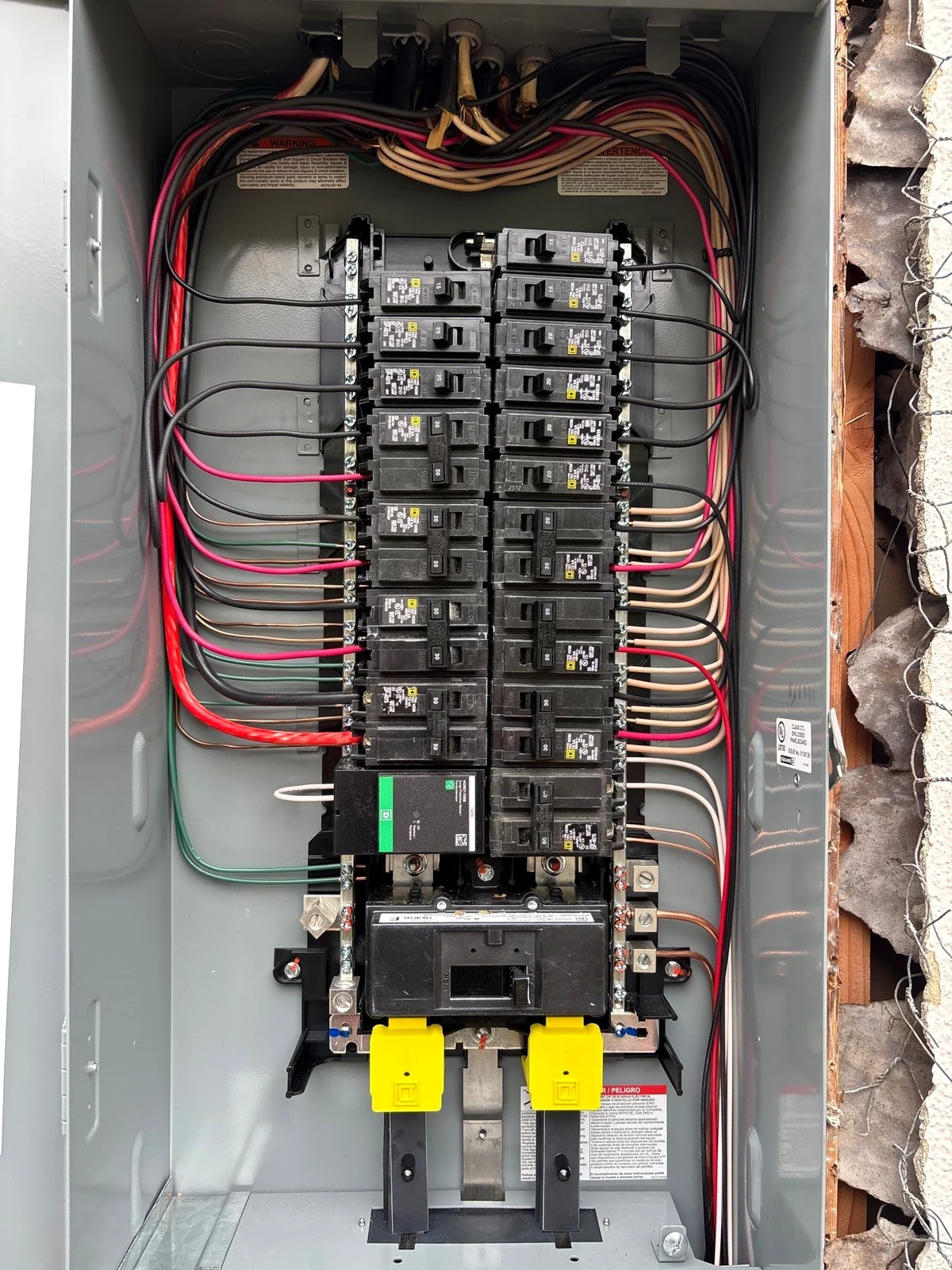
A couple of plain-language notes. The "bus bar" is the metal spine inside the panel that the breakers clip onto and that carries the power. Visi-Trip means a red window shows when a QO breaker trips, so you spot it without testing each breaker by hand. And because QO breakers are narrower (3/4 inch instead of a full inch), a QO box of the same size holds more circuits.
One honest caveat. Not every QO load center has a copper bus. Schneider sells some QO models with a tin-plated aluminum bus, so we verify the model spec rather than promise copper. Most current QO plug-on-neutral residential panels use a shielded copper bus, but we check the one for your wall.
Book a free on-site assessment. We give you a straight answer and a flat-rate price in writing, with no obligation.
Aluminum vs Copper Bus, and Why It Matters Less Than You Think
Homeline uses a tin-plated aluminum bus and most QO models use a tin-plated copper bus, and yes, copper is the nicer material, but aluminum is not a hazard. Copper has lower electrical resistance and sheds heat a little better, which is where its quality reputation comes from. A modern aluminum bus inside a UL-listed panel is fully code-compliant and safe when it is installed right, mainly by torquing each breaker connection to spec.
Aluminum's bad name comes from a different problem. In the late 1960s and 1970s, some homes were wired with solid aluminum branch wiring, the actual circuit wires running to outlets and switches, and those connections could loosen and overheat over time. That is a real issue worth fixing if your home has it, but it has nothing to do with a modern, listed aluminum bus bar in a new Square D panel. So if a contractor tries to talk you out of Homeline by making the aluminum bus sound dangerous, that is a red flag about the contractor, not the panel. Copper is a nice-to-have, not a safety requirement.
Is QO Worth the Extra Cost for a South OC House
Usually the QO upcharge is a small slice of a full panel upgrade, so it is worth it when you will use what it buys and skippable when you will not. Retail prices move, so your written quote is what counts.
On standard breakers the gap is tiny. A basic 20-amp single-pole breaker runs roughly $9 for a Homeline (HOM120) and around $10 to $29 for the QO equivalent (QO120), often just a couple of dollars apart. The gap widens on specialty breakers, the arc-fault (AFCI), ground-fault (GFCI), and dual-function breakers that modern code requires on many circuits. QO versions of those run roughly 20 to 50 percent more, and a panel full of them is where the QO premium adds up.
On the panel can itself, a 200A Homeline load center runs roughly $100 to $300 and a comparable QO runs roughly $170 to $600, so the QO box is usually 15 to 30 percent more. The honest headline is that on a full 200-amp service upgrade, the QO-versus-Homeline equipment difference is usually a few hundred dollars, not thousands. Labor and permitting dominate the bill either way. For how the whole job prices out locally, see our breakdown of panel upgrade cost in Orange County.
Go QO if you are staying in the home long term, electrifying heavily (an EV charger plus a heat pump plus a heat-pump water heater), you want the plug-on-neutral AFCI and GFCI breakers that snap in cleanly, or you like the red trip-indicator window for troubleshooting. Homeline is perfectly adequate for a standard load, a budget-sensitive job, or a home not headed toward heavy electrification.
Can You Mix Breakers, and Will Parts Be Around in 15 Years
No, QO and Homeline breakers are not interchangeable, and the breakers always have to match the panel they are listed for. They connect to the bus differently (the QO copper jaw-clip versus the Homeline aluminum stab) and are different sizes, and a breaker that physically fits is not the same as one that is listed for that panel.
This is where code matters. The National Electrical Code (NEC 110.3(B)) requires equipment to be used the way it was tested and listed, and panels and breakers are listed together as a system. Putting the wrong breaker in (a different brand or just the wrong Square D line) violates that listing. It can fail your inspection, void the panel warranty, and create headaches with your insurance. Some UL-classified cross-brand breakers exist, but they come with a short, specific list of approved panels and still have to be verified, so we do not freelance it.
On future availability, both lines are easy to source. QO is the most widely stocked breaker line in North America, with the deepest catalog of specialty AFCI, GFCI, and plug-on-neutral breakers. Homeline is also stocked everywhere and is cheaper on standard breakers. Both will be easy to find for decades, but QO has the broadest long-term parts ecosystem, which matters more on a home you plan to own for 15-plus years.
QO for a 200-Amp Upgrade, and How It Stacks Up to Eaton and Siemens
Most electricians reach for QO on a 200-amp residential upgrade, and we usually do too, for the copper bus, the Visi-Trip window, the breaker availability, and the full plug-on-neutral AFCI and GFCI catalog. Homeline is the value pick and is genuinely fine for a standard 200-amp home. Here is how Square D compares to the other big names.
- Eaton. The economy line is BR, which competes with Homeline, and the premium line is CH, a well-regarded bolt-on panel with a copper bus and tan handles where the breakers screw down rather than snap on. Eaton sometimes prices above Square D.
- Siemens. Solid and reliable, often the most budget-friendly of the majors, and electricians like the roomy neutral and ground space inside Siemens panels for clean wiring.
- Square D. QO is the do-it-once-right default and Homeline is the value line. One correction worth keeping straight, residential QO breakers plug on, they are not bolt-on. The bolt-on premium line people picture is Eaton CH (Square D's bolt-on, QOB, is the industrial version).
The verdict is not dramatic, and that is the point. All of these brands make code-compliant, UL-listed panels that serve homes safely for decades, and the differences are real but incremental. We install all of them and recommend per home. For a South OC house headed toward an EV charger and a heat pump, QO is our usual pick. For a standard load on a budget, Homeline, BR, or Siemens are all smart.
Why the brand choice ties into the SCE electrification wave
South Orange County runs on Southern California Edison (SCE), and many of our panel upgrades are driven by electrification, homeowners adding EV chargers, heat-pump HVAC, and heat-pump water heaters. SCE has run incentive programs tied to panel upgrades and 240-volt circuits, and those amounts change, so we confirm current figures before we quote them. If you are electrifying an older South OC tract home that still has 100-amp or 125-amp service, it maxes out fast once the EV charger and heat pump arrive, and the QO-versus-Homeline choice usually lands right inside that 100-to-200 amp upgrade. To check whether you need the jump, see our guide on whether your South OC home needs a 200-amp panel.
Whichever line you land on, a California-licensed electrician has to pull the permit and the job gets inspected, which is exactly why matching the right breakers to the right panel matters. We handle the permit, the inspection, and the SCE meter release. Browse the brands we install, check our pricing, and book a free assessment. We give you the honest answer, even when it is that Homeline is all you need.