Why insurers keep flagging FPE and Zinsco panels
Both brands have a long, documented record of breakers that fail to trip when they should. A breaker is the safety switch that cuts power the instant a circuit overloads or shorts. With Federal Pacific Electric (FPE) "Stab-Lok" and Zinsco panels, decades of testing has shown those breakers can do nothing while the wire behind your wall keeps heating up. That is how a panel starts a fire, and why most California carriers treat these brands as a red flag.
This covers a lot of South Orange County. FPE panels went into millions of American homes from roughly 1950 into the early 1980s, and Zinsco (also sold as Sylvania, GTE-Sylvania, or Magnetrip) showed up in homes built around 1963 to 1981. That is a big share of the older tract homes from Mission Viejo and Lake Forest to Laguna Hills and San Clemente. Panels are all we do, so we have opened plenty of these boxes. Below is the honest picture of what the record says, what your insurer reacts to, and the real fix.
The history behind Federal Pacific (FPE) Stab-Lok
FPE Stab-Lok breakers can fail to trip on an overload or short, and that defect has been tied to the company misrepresenting safety certifications. In June 1980, the company that then owned FPE reported to the U.S. Consumer Product Safety Commission (the CPSC) that many of its breakers did not meet Underwriters Laboratories (UL) requirements, even though they carried UL labels. In 2002, a New Jersey court found that FPE "knowingly and purposefully distributed circuit breakers which were not tested to meet UL standards as indicated on their label."
The CPSC ran a two-year investigation in the early 1980s with its own lab testing, and secondary reporting of that data describes very high failure rates, including a large share of breakers that would not trip. Independent engineers, most notably Dr. Jesse Aronstein, have tested Stab-Lok breakers against the UL 489 standard since the 1980s and keep finding failure rates no modern panel would pass.
There was no federal recall of FPE panels. The CPSC closed its investigation in 1983 citing limited budget and the cost of further study, not a clean bill of health. Its closing statement said the available data did not establish a serious risk, but it explicitly did not declare the panels safe. The honest framing is that no recall was ever issued, yet the hazard is heavily documented by independent engineers and the courts. Do not believe anyone who says it was recalled and handled, or that the government cleared it.
One engineering estimate from Aronstein and a co-author put FPE-related failures at roughly a couple thousand fires a year nationwide. Treat that as an estimate, not an official count; either way, insurers stopped waiting for a recall long ago.
Book a free on-site assessment. We give you a straight answer and a flat-rate price in writing, with no obligation.
The history behind Zinsco and GTE-Sylvania
Zinsco panels fail in a quieter way, where the breaker can weld itself to the bus bar and keep feeding power while losing the ability to trip. Inside a Zinsco panel, the breakers clip onto an aluminum bus bar. Over years of use, that connection can loosen, arc, and overheat, and the heat can fuse the breaker to the bus. At that point the breaker looks fine and still powers your outlets, but can no longer cut the circuit. The danger stays invisible until the day there is a real overload and nothing trips.
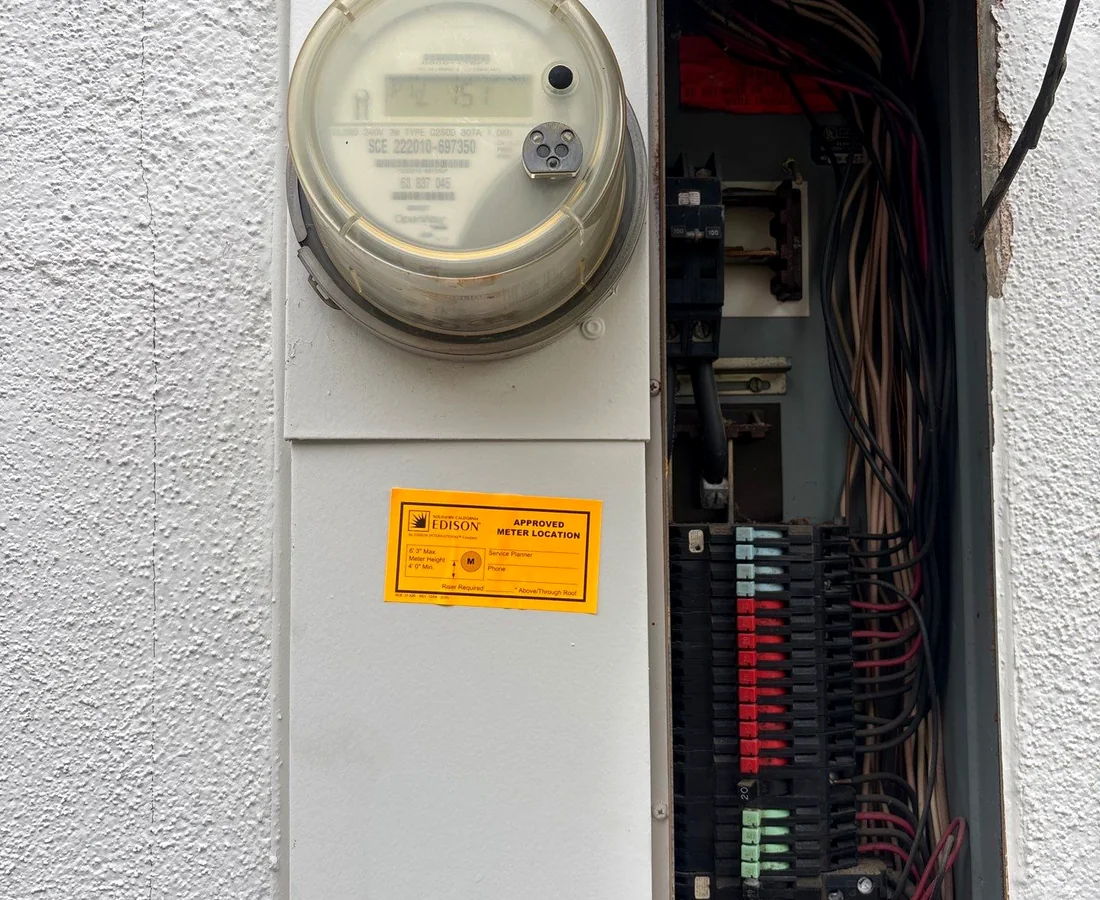
Aluminum parts plus coastal moisture make this worse, which we see closer to the water in Dana Point, Laguna Beach, and Newport Coast. Salt air speeds up corrosion on the bus, and corrosion is exactly where these connections fail. Testing in the inspection trade has found that a meaningful share of Zinsco breakers failed to trip as designed. To be straight, those numbers are less rigorously published than the FPE data, but the behavior is well understood by electricians and inspectors.
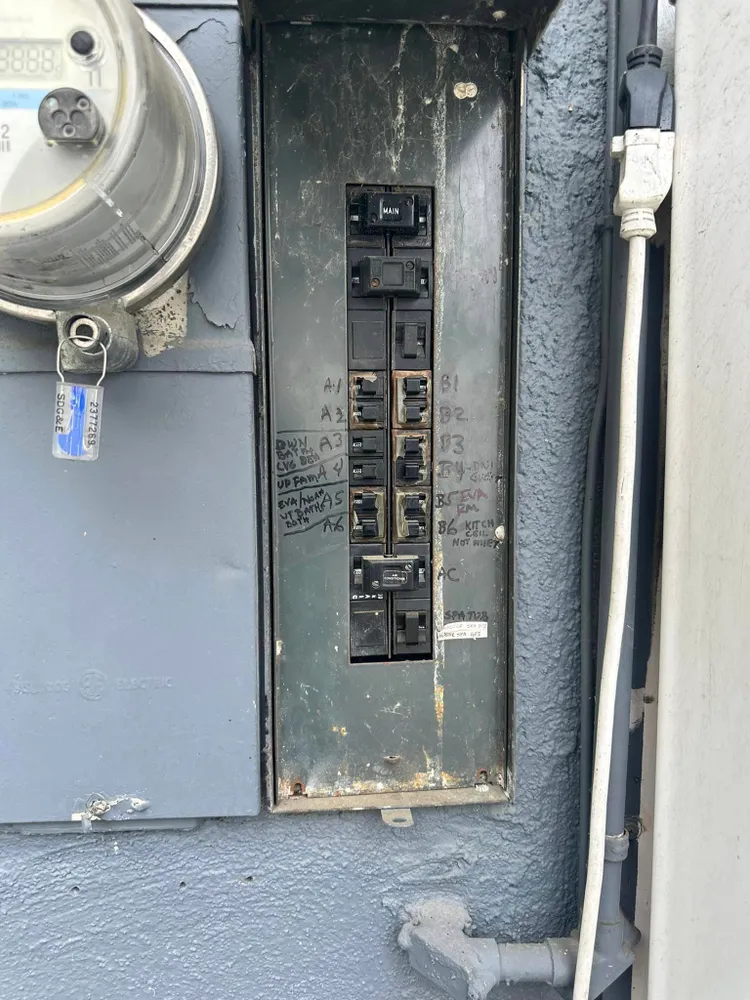
Warning signs a homeowner might notice include flickering lights, a section of the house losing power, a faint burning smell near the panel, breakers that are hard to reset, or white, green, or black buildup on the metal inside the box.
How to tell if you have one (without touching anything)
You can identify these panels by reading the labels and looking at the breaker handles, and you should never pull breakers, touch the bus, or remove the panel cover. Diagnosis and replacement are for a licensed electrician, because the panel cover (the deadfront) protects live parts.
| Clue | Federal Pacific (FPE) Stab-Lok | Zinsco / GTE-Sylvania |
|---|---|---|
| Label to look for | "Stab-Lok," "Federal Pacific Electric," or the FPE logo, inside the door or on the deadfront | "Zinsco," "Sylvania," "GTE-Sylvania," or "Magnetrip" |
| Breaker handles | Often a thin red stripe or marker across the toggle | Often colored handles in red, green, and blue (vs. all-black modern breakers) |
| Home era | Roughly wired 1950 into the early 1980s | Roughly wired 1963 to 1981 |
If you also see the name Federal Pioneer, that is the Canadian sibling of Stab-Lok and shares the same design and failure tendencies. A few other older brands (Pushmatic, certain Challenger models, Wadsworth) get flagged too, but mostly for age and case-by-case issues, not the documented record FPE and Zinsco carry. Those two are what your insurer cares about most, so we keep the focus there.
The safest way to find out is to open only the outer door (not the cover), photograph the labels and breaker handles, and text it to us at (949) 799-2034. We can usually name the brand from the picture, for free, before anyone comes out.
The insurance and resale reality in South OC
Many California carriers will not write or renew a policy on a home with an FPE or Zinsco panel, and these panels regularly hold up home sales. After years of wildfire losses and the 2025 fires, the California insurance market is tight, and carriers are quick to decline any documentable risk. An FPE or Zinsco panel is an easy, photographable reason to say no, which is what turns a someday project into a this-month project for a lot of our neighbors. Here is how it usually shows up:
- Non-renewal. Your carrier declines to renew at your next term, often with a 30 to 90 day window to replace the panel.
- Denied or pricier new coverage. A new policy gets refused, or you get pushed into the high-cost surplus market at several times standard pricing.
- Escrow trouble. A buyer's inspector flags the panel, the lender or insurer requires it fixed, and the replacement often has to happen before the sale can close.
New for 2026, California's SB 382 requires sellers of single-family homes to give buyers a written disclosure advising a professional electrical inspection, and noting that substandard wiring may pose a fire risk and make insurance hard to get. So every South OC home sale from here forward puts the panel on the table, and getting ahead of one now beats fixing it under an escrow clock.
The real fix (and the trap to avoid)
The fix is a full panel replacement with a new, UL-listed panel and breakers, and you cannot reliably solve this by swapping in new breakers. This is the most important misconception to clear up. Aftermarket and replacement breakers for Stab-Lok and Zinsco have tested about as unreliably as the originals, because the problem is the design and the bus-bar connection, not one bad breaker. Inspection authorities are explicit that replacement breakers are unlikely to reduce the risk. Most electricians, ourselves included, recommend replacing the whole panel. When you are ready, here is how we handle a Federal Pacific panel replacement and a Zinsco panel replacement across South Orange County.
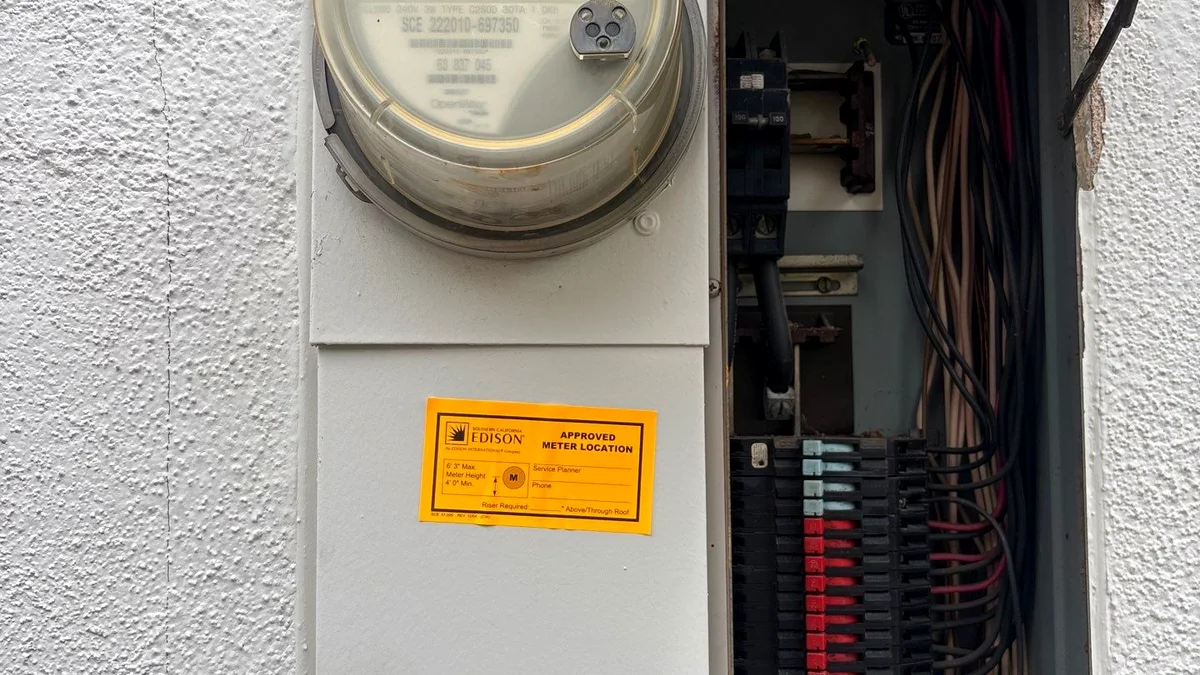
We won't fear-monger either. These panels are a documented fire hazard and an insurance liability, and replacement is the standard recommendation. But it is not accurate to say every panel will burn your house down or that there was a recall.
For help right-sizing the new panel, see our guide on whether your home needs a 200-amp panel. If an EV charger is on your radar, read why the panel comes before the charger.
What replacing it looks like with us
A standard FPE or Zinsco swap is usually a one-day job, and we handle the permit, inspection, and Southern California Edison coordination for you. A panel replacement in Orange County requires a city permit, a final inspection, a licensed electrician, and an SCE meter release (the utility disconnect and reconnect at the meter). Power is typically off for several hours the day of the swap, then back on once the new panel is tested.
See our full services and the brands we replace. What to count on:
- A free on-site assessment and a flat-rate quote in writing before any work starts.
- Financing with approved credit, including $0-down monthly options, plus our current $500 off a 200-amp upgrade.
On price, real South OC panel replacements generally land in the $2,500 to $6,500 range, depending on amperage (100A vs 200A service), wiring condition, whether the panel needs relocating, and any service-entrance work the swap triggers. We do not quote a final number sight unseen, so you get a flat-rate figure in writing after the free assessment. You may hear about possible SCE rebates tied to EV or electrification programs; those change and have conditions, so we verify eligibility with SCE rather than promising an amount.
We are a family-owned, C-10 licensed contractor (CSLB #1084610), insured and bonded, serving South Orange County with a 5.0 Google rating from local homeowners. Found an FPE or Zinsco label on your box? Book a free assessment or call (949) 799-2034.