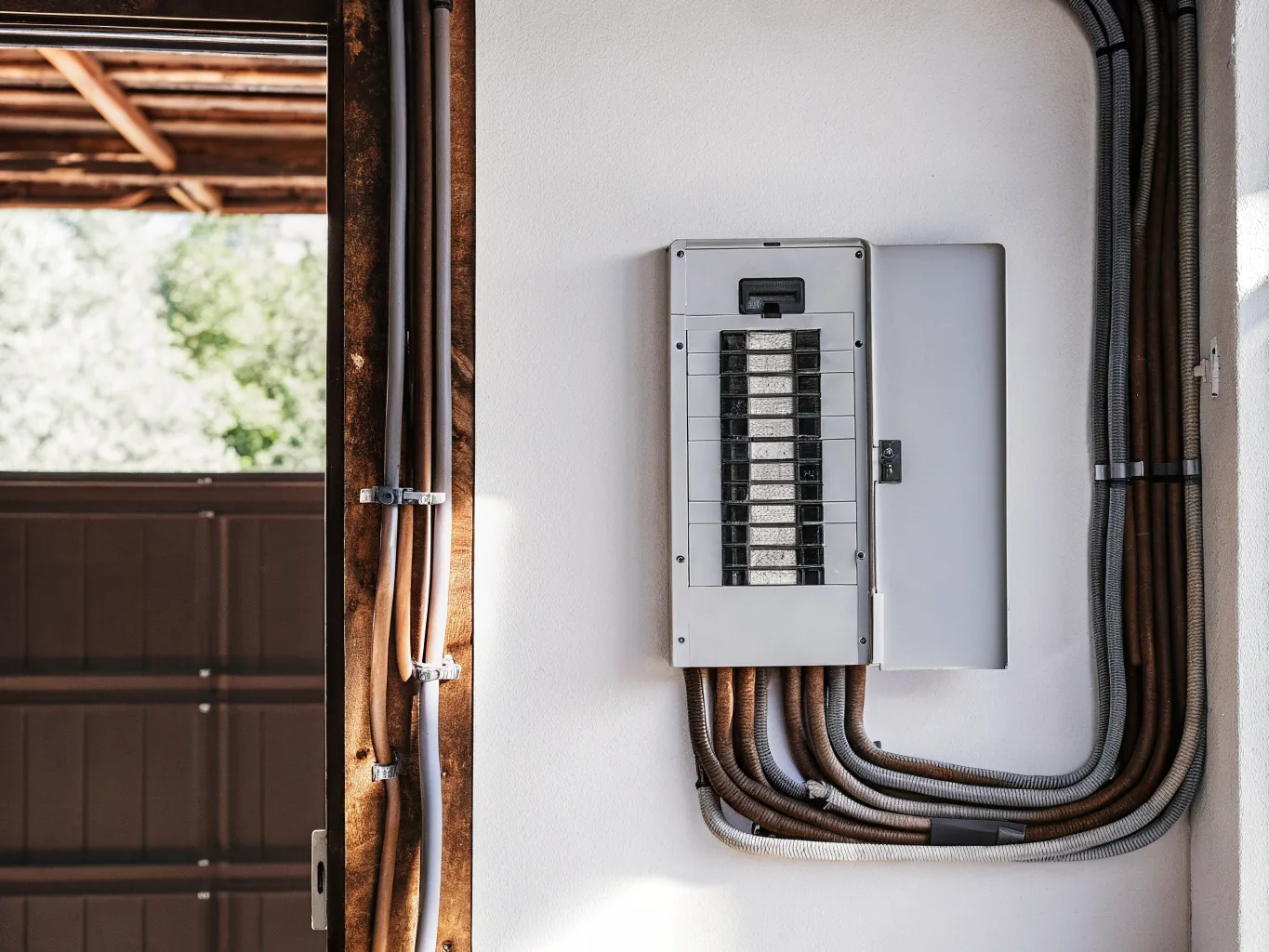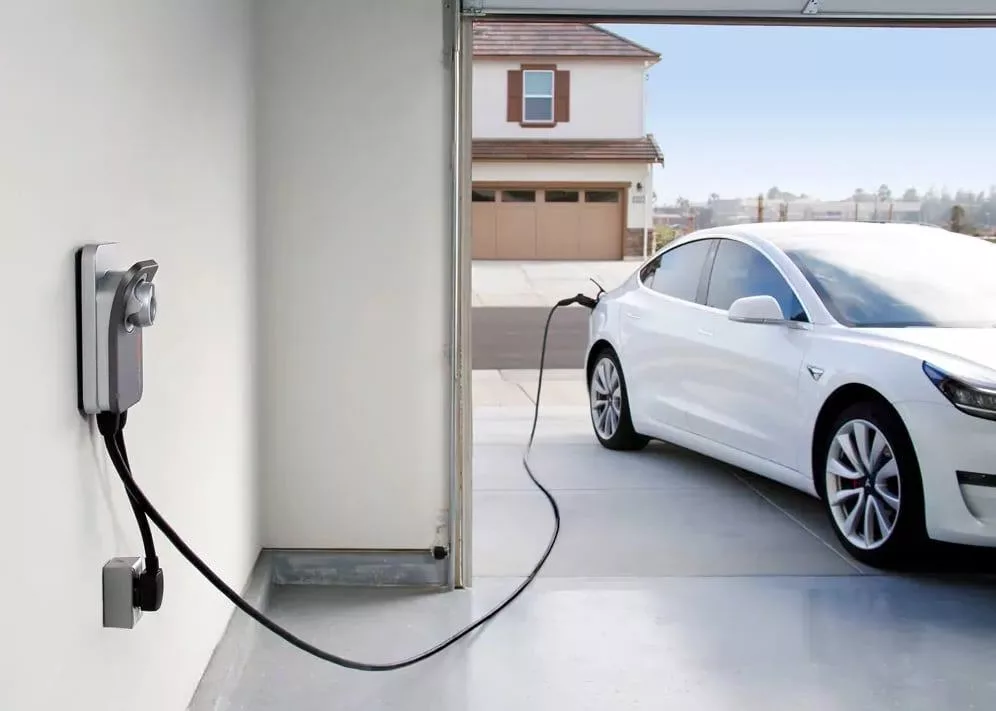
The charger is the easy part
If you are pricing a home EV charger, here is the short version. The charger on the wall is the cheap, fixed part, and your panel is the variable that decides what the whole project costs. A quality Level 2 charger runs roughly $200 to $750. The wiring and panel work behind it can range from a few hundred dollars to several thousand.
Charging speed drives that. The National Electrical Code (the NEC, or NFPA 70) treats EV charging as a continuous load, current that runs for three hours or more, and continuous loads must be sized at 125 percent of the draw. Said the other way, you only load a breaker to 80 percent of its rating. That is why a "40-amp charger" actually eats a 50-amp slice of your panel.
| Charger output (continuous) | Circuit / breaker needed | Real-world delivery |
|---|---|---|
| 32A | 40A breaker | ~7.7 kW (common cap on plug-in units) |
| 40A | 50A breaker | ~9.6 kW (max for a NEMA 14-50 plug-in) |
| 48A | 60A breaker | ~11.5 kW (most common hardwired speed) |
| 80A | 100A breaker | ~19.2 kW (rare, overkill for most cars) |
Two things matter here. A NEMA 14-50 outlet is capped at 40 amps continuous, and many plug-in chargers self-limit to 32 amps, so a 14-50 outlet tops out around 9.6 kW, often 7.7 kW. To charge faster you have to hardwire, and a 48-amp charger like a Tesla Wall Connector needs a dedicated 60-amp circuit and adds roughly 35 to 44 miles of range per hour. Going past 48 amps does nothing for most current EVs, since most accept only 48 amps on AC.
Does your panel actually have room?
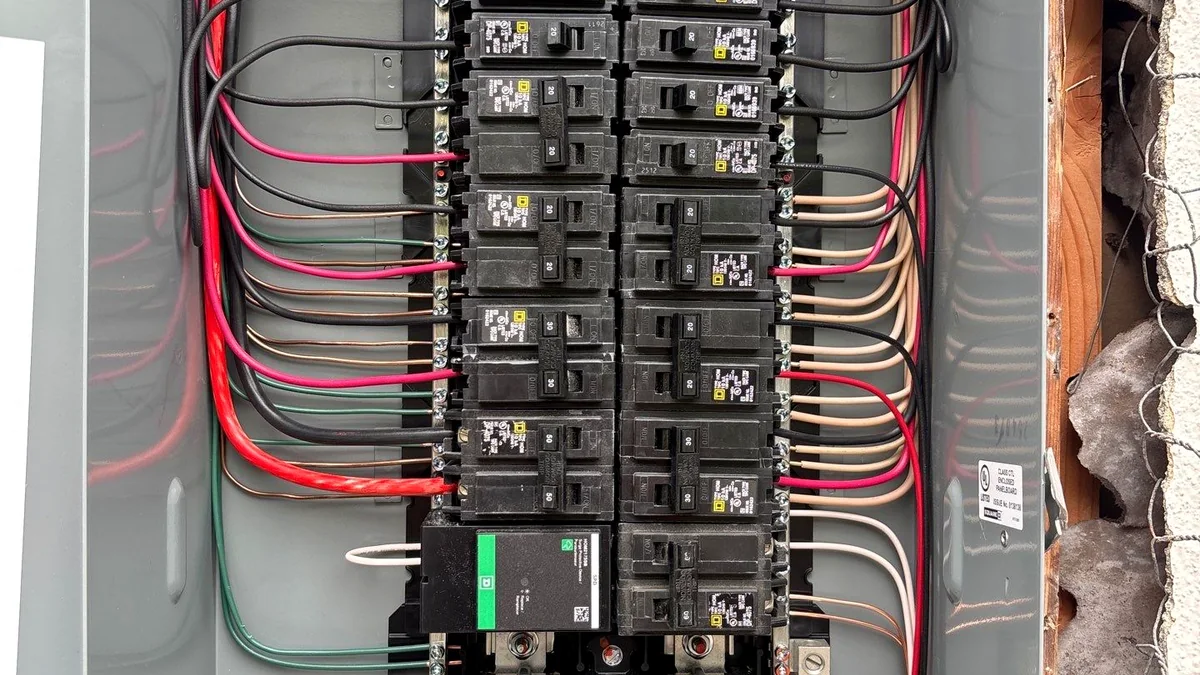
This is where the cost lives, and it comes down to two separate questions homeowners tend to mix up. Do you have spare amperage, and do you have spare breaker slots? You can have one without the other.
Do you have spare power?
You cannot answer this by counting empty breakers, because adding up breaker ratings is not the test. The test is a load calculation. The method that helps existing homes most is the metered-data method (NEC 220.87), which lets us pull 12 months of Southern California Edison interval data and use your home's actual peak demand instead of a worst-case theoretical sum. Because real homes never run everything at once, a proper load calc frequently proves an upgrade is unnecessary.
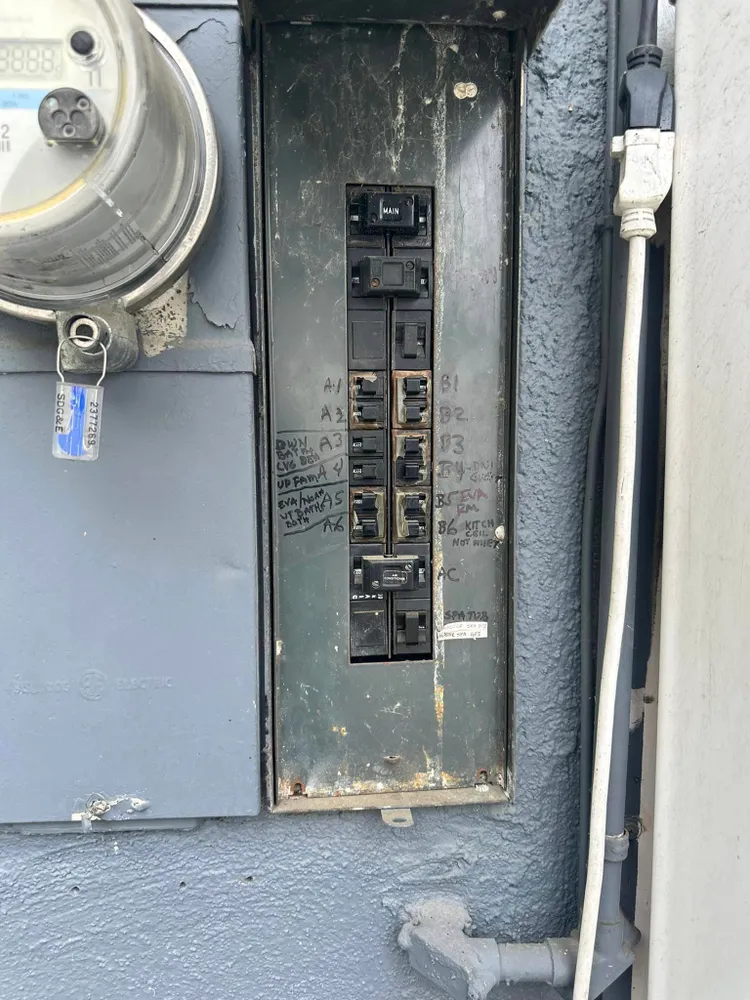
A typical 100-amp panel, common in older Mission Viejo, Lake Forest, and Laguna Hills tracts, may already be near its limit running a dryer, an oven, and air conditioning, so stacking a 40 to 50-amp EV circuit on top can trip the main. 100-amp homes are the most likely to need help. A 200-amp panel usually has room for a Level 2 charger to spare.
Do you have two open slots?
A 240-volt EV circuit needs a double-pole breaker that takes two adjacent slots, because it bridges both 120-volt legs. The point people get wrong is that a tandem breaker (a cheater or twin) cannot supply 240 volts. It sits on a single leg and only makes 120 volts, so you cannot free up space by swapping one in. Plenty of older South OC panels are physically full, and the fix is reshuffling existing 120-volt circuits to open two slots, or adding capacity.
Book a free on-site assessment. We give you a straight answer and a flat-rate price in writing, with no obligation.
Your options when the panel is full or maxed
Most homeowners assume a full panel means a new 200-amp service. It does not. There are three real paths, and the load calculation tells us which one fits.
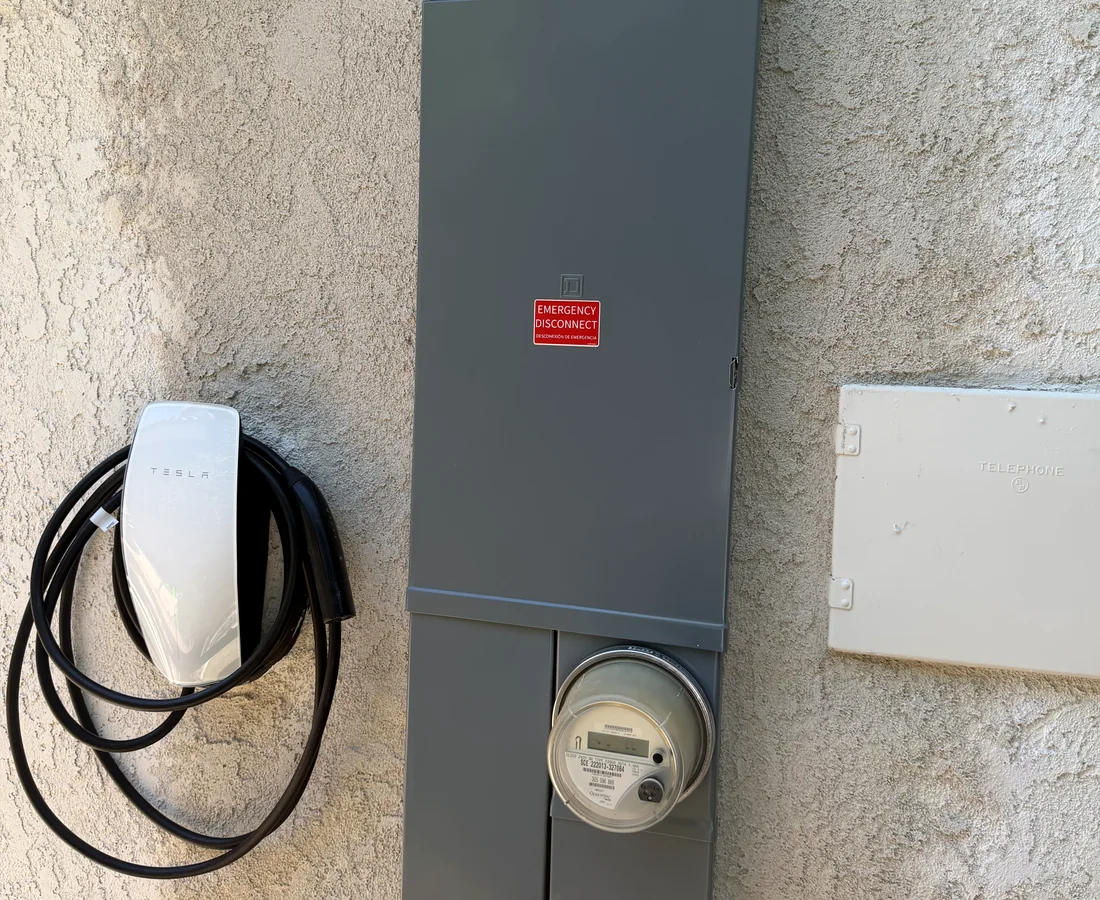
- Add a subpanel. A small 60 or 100-amp subpanel, usually in the garage, is fed from your main and gives you slots for the EV circuit plus room for future ones. The right move when the main service has amperage headroom but is just out of slots.
- Add a load management device (EVEMS). NEC 625.42 allows a listed system that watches your home load in real time and throttles or pauses the charger so the service is never overloaded, which often avoids an upgrade entirely. Some are whole-panel monitors; others are circuit-sharing splitters that let the EV share an existing high-draw circuit like the dryer. It limits charging speed when the house is busy and does not add capacity for the next appliance, so it fits a one-car household with no other electrification planned.
- Upgrade the service to 200-amp. The full fix when the load calc shows you are genuinely out of amps. We replace the panel, and sometimes the meter or service entrance, then size you for the future.
If your panel is an obsolete, hazard-flagged brand from the Federal Pacific or Zinsco era, common in 1960s to 1980s South OC tracts, no reputable electrician will add an EV circuit to it. Those panels carry well-documented failure risks, and many insurers will not write or renew a policy on a home that has one, so the EV project is really a panel-safety project. More in our guide to Federal Pacific and Zinsco panels and insurance.
Why we say size it once
If electrification is anywhere in your plans, going to 200-amp now is almost always cheaper than upgrading twice. 200-amp is the modern default and comfortably handles one EV charger plus a heat pump HVAC system plus standard loads. The trap is the electrification trifecta, where an induction range, a heat pump water heater, and a heat pump dryer can push a home past 100 amps on their own, before an EV.
The slow, expensive parts of an upgrade (the panel swap, the permit, the SCE coordination, the inspection) you pay for once. Size to 200-amp now and the next EV, heat pump, or range is a quick add-a-breaker job. See who actually needs the jump in our guide on whether your South OC home needs a 200-amp panel. The honest caveat is that with a 200-amp panel and no other plans, you may need only a breaker and a circuit. Our edge is doing the math first.
Permits, inspection, and SCE coordination
Any new circuit, wiring, or panel work needs a permit and an inspection in Orange County. The only common no-permit case is plugging a portable Level 1 cord into an existing 120-volt outlet. That final inspection is your proof the install is safe. California's AB 1236 requires every city to offer an expedited EV-charger permitting process, and permits go through each city's building department (or OC Development Services for unincorporated areas like parts of Coto de Caza). Fees are modest, commonly $50 to $200. We pull the permit and schedule the inspection for you. Your city building department, or OC Public Works for unincorporated areas, publishes the residential EV charger permit requirements.
SCE coordination only enters the picture for a service upgrade; a simple charger or circuit install does not involve the utility. A service upgrade means Southern California Edison may need to approve the meter location and pull and reset the meter, commonly a one to two day step. The panel swap itself is typically 4 to 8 hours. Most of our 200-amp upgrades finish in a single day, and we coordinate the SCE meter release so you are not stuck on hold.
Ask about SCE's Charge Ready Home program. Income-eligible residents can get a rebate toward upgrading the panel to 200-amp and installing a 240-volt EV circuit (the rebate amounts and eligibility tiers change, so we confirm SCE's current terms with you). Pair that with our current $500 off a 200-amp upgrade and the math changes fast. On SCE's TOU-D-PRIME plan, the cheapest super off-peak window is the 8 a.m. to 4 p.m. daytime block in the winter season (roughly October through May); in summer the lowest rates shift to overnight, so check the current schedule. See SCE's EV rate plans and Charge Ready Home.
What it actually costs in South OC
The panel is the swing factor, not the charger. Charger hardware is separate, typically $200 to $750. South OC labor runs toward the higher end of each range below, and we give a flat-rate price in writing after a free assessment.
- A NEMA 14-50 outlet when capacity and slots already exist runs about $300 to $1,200, which is the best case.
- A hardwired 48-amp charger where capacity exists on a short run runs about $1,000 to $1,500-plus.
- A long wire run, outdoor work, or trenching adds roughly $10 to $20 per foot.
- Adding a 60 to 100-amp subpanel runs about $500 to $1,500, plus the charger circuit.
- A load management device runs about $800 to $1,500 for an EMS, or $300 to $500 for a splitter.
- A 100-amp to 200-amp service or panel upgrade runs about $1,500 to $4,000 for a typical job, including permit and inspection. Coastal or long-run jobs push higher.
You will see ranges online as wide as $2,000 to $25,000-plus, but that high end is rare and reflects worst cases like a full service rebuild or a trenched line. For a typical South OC job, $1,500 to $4,000 is the everyday range.
Common myths we hear every week
A few quick corrections, because each can cost you money.
- "I have empty slots, so I'm fine." Slots are not amps. It takes a load calculation, not a slot count.
- "A 14-50 outlet gives the fastest charge." No. A plug-in is capped at 40 amps, often 32. Faster (48 amps) means hardwiring, and more amps only helps up to your car's onboard limit.
- "I can use a tandem breaker to make room." A tandem cannot supply 240 volts. An EV circuit needs a true double-pole breaker in two adjacent slots.
Panels are all we do, as the panel-only division of All Thingz Electric, a family-owned, C-10 licensed California contractor (CSLB #1084610) serving South Orange County. If you are eyeing an EV charger and are not sure your panel is ready, that is the question we answer for free. See what your neighbors say, check current pricing, or book your assessment.