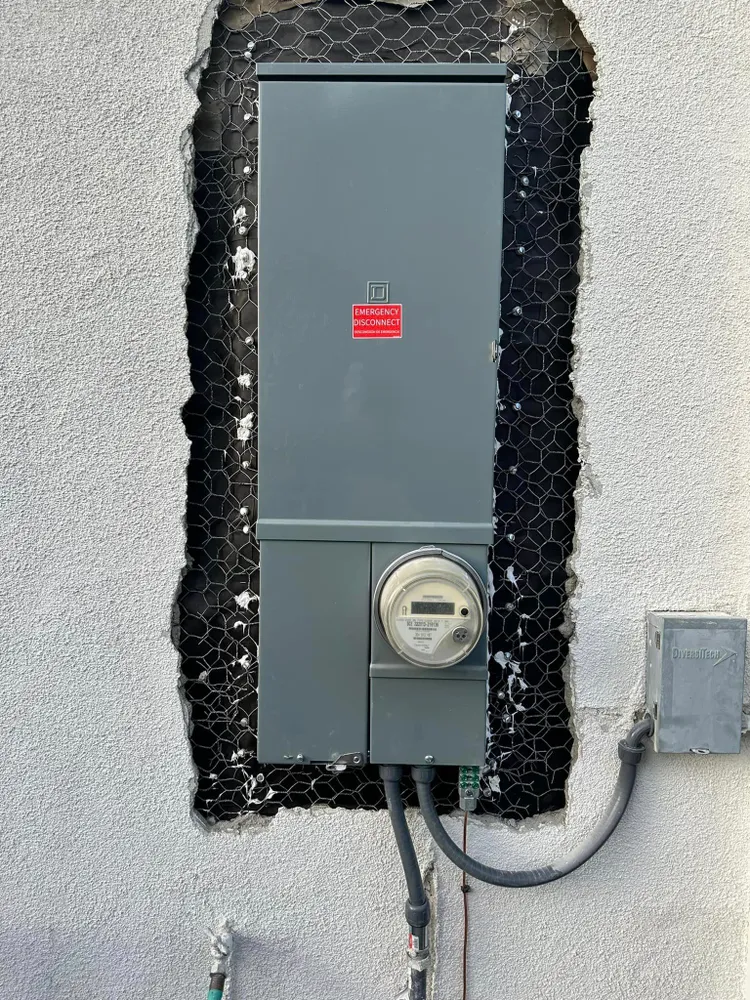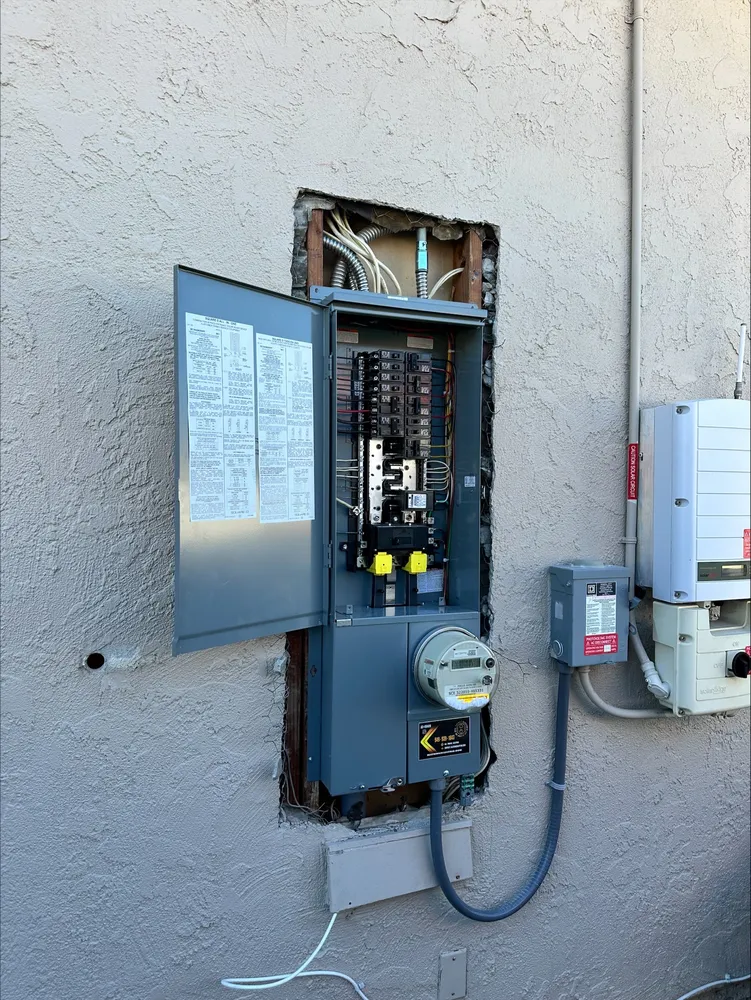
Do this right now
A burning or fishy smell from your breaker box means something inside is overheating, so act on it the same hour you notice it. Work through these steps in order.
- If you see smoke, flame, or sparks from the panel, get everyone out and call 911 first. Do not stay to investigate, and never throw water on an electrical fire.
- Stay back several feet from a sparking or arcing panel. It can throw molten metal and cause an arc flash, so do not walk up for a closer look.
- If, and only if, it is safe to reach the panel (no smoke, no sparks, and the panel and wall are not hot), switch off the main breaker at the top. That cuts power to the whole house. Use one hand and stand aside.
- Do not open or remove the panel cover. Behind it are exposed, energized parts, and this is the single most important rule on this page.
- Do not flip the smelly breaker back on or keep resetting one that keeps tripping. The trip is the breaker warning you, and resetting forces current back through a failing connection.
- Turn off and unplug heavy loads from the wall side (EV charger, dryer, oven, space heaters), never from inside the panel.
- Call a licensed electrician for same-day or emergency service, tell them what you smell, hear, and see, and leave the main off until a pro looks at it.
This lines up with guidance from the Electrical Safety Foundation International (ESFI) and the NFPA, which treat burning smells, buzzing or sizzling sounds, repeatedly tripping breakers, and warm or discolored devices as serious warning signs. Turn off power if it is safe, and call a qualified electrician rather than fixing it yourself.
What that fishy or burning-plastic smell actually is
That fishy or hot-plastic smell is the smell of electrical parts overheating until the plastic around them starts to break down. It is not a dead animal in the wall or a plumbing problem. Inside a breaker box, electricity runs through metal connections wrapped in plastic, and when a connection goes bad it gets hot. That heat melts the plastic on the wires and breaker housings, which gives off a sharp, acrid burning-plastic smell.
The fishy or ammonia-like odor is the same problem caught a little earlier, as the heat-resistant plastics and flame-retardant chemicals start to break down before they fully burn. So a fishy smell is often the early warning, and burning plastic means it has gone further. Either way, a component is cooking itself. For scale, ESFI ties home electrical fires to roughly 51,000 fires and about $1.3 billion in property damage in the United States each year.
Book a free on-site assessment. We give you a straight answer and a flat-rate price in writing, with no obligation.
When crackling or popping means active arcing
If a smell comes with crackling, sizzling, popping, or visible sparks, that is active arcing, and you should treat it like a fire that has already started. Arcing is electricity jumping a gap between two metal surfaces that should be solidly connected, and an electrical arc can exceed 10,000 degrees Fahrenheit, hotter than the ignition point of the wood, insulation, and dust around your panel.
A faint, steady hum can be normal, but crackling, sizzling, popping, or any new or louder buzzing paired with a smell, heat, or scorch marks is an emergency. Arcing is a leading cause of fire, not a rare edge case, and ESFI ties more than 28,000 home fires a year to arcing faults. If you hear it, stay back, kill the main only if it is safe, and call for emergency service.
Is this an emergency, and how close is too close
A burning smell from your panel is always urgent, and it becomes a call-911-first emergency the moment there is smoke, flame, or sparks. If you see any of those, get everyone out and call 911 first, and never use water on an electrical fire. If the panel is sparking or arcing, stay several feet back, because an arc flash can throw molten metal, and do not approach even to reach the main.
When the only signs are a smell, warmth, or buzzing, and the panel and wall are not hot, switching off the main is the right move, because it removes the energy feeding the problem. But if the box is actively crackling or sparking, any distance where flying molten metal could reach you is too close, so leave the power on and wait for help.
Why you must not open the panel or reset the breaker
Never open the panel cover or keep resetting a tripping breaker, because both put you between live electricity and a fault that is already failing. The panel cover, called the deadfront, is the only thing between you and exposed, energized busbars and lugs. Pulling it off to find the bad breaker risks electric shock and an arc flash. Investigating inside the panel is a licensed electrician's job for exactly this reason.
Resetting a tripping breaker is the other trap. A breaker that keeps tripping is protecting the house, not being annoying. Each reset forces current back through a circuit that is overloaded or faulting, which is how an overheating connection turns into a fire. Leave a smelly or tripping breaker off and call us. For more, see our guide on whether a tripping breaker is a bad panel or a bad breaker.
"The breaker would have tripped if it were really dangerous" is not true. Loose-lug overheating, corroded contacts, and aging Federal Pacific or Zinsco breakers commonly overheat or fail without ever tripping. A breaker that never trips is not proof of safety.
What is actually causing it
The smell almost always traces back to a physical defect inside the panel. These are the causes we find most often in South Orange County.
Loose connections at the lugs and terminals
This is the most common cause, and the sneakiest. A loose connection reduces metal-to-metal contact, which raises resistance and concentrates heat at one point. The heat oxidizes the metal and loosens it further, a slow runaway loop that quietly cooks the connection until it scorches or melts, often without ever tripping the breaker. The fix is for a pro to de-energize the panel and tighten the connection to the manufacturer's exact spec with a torque tool, or replace the damaged part.
Overloaded or undersized panels
Too much load on one circuit heats the wires until the insulation softens and smells, which is common with space heaters and large appliances. Many older South OC tract homes also still run on 100-amp service. Add an EV charger (30 to 60 amps), a heat pump (30 to 60 amps), or an induction range (40 to 50 amps), and you can push a 100-amp panel past what it was built for. A heat pump plus an EV charger usually is not manageable on 100 amps, and the fix is often a 200-amp upgrade. To see whether your home is in this group, read our guide on the signs an electrical panel is failing.
Coastal salt-air corrosion
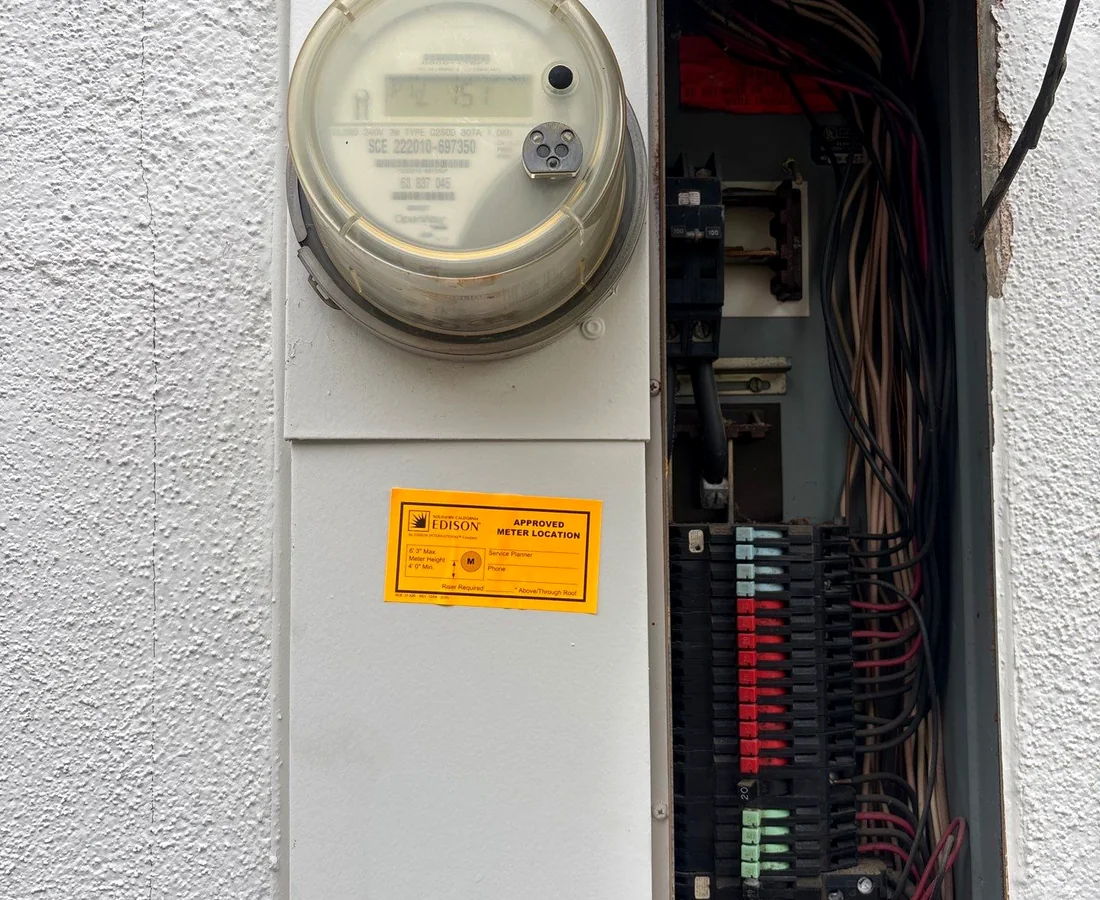
This is the South Orange County wildcard. Salt-laden marine air leaves a film inside the panel that holds moisture and speeds up oxidation. Corroded busbars, screws, and breaker contacts have higher resistance, which means more heat, melted insulation, and breakers that can seize and fail to trip. Rust can even rot the steel enclosure, so a coastal panel can wear out in well under half the lifespan of an inland one. We watch for this in San Clemente, Dana Point, Laguna Beach, and Newport Coast, where humidity often sits in the 60 to 80 percent range. The tells are orange or brown staining, or green or white powdery buildup on the wires or bus.
Aging or defective equipment
Federal Pacific (FPE Stab-Lok) and Zinsco-era panels are known fire hazards because their breakers frequently fail to trip under an overload or short. Independent testing has found very high failure rates in these designs, and some insurers now refuse or cancel coverage on homes that still have them. For these, the fix is a full panel replacement.
Will the smell go away on its own, and what the fix costs
No, the smell will not go away on its own, because it is a symptom of a physical defect that does not heal itself. A loose, corroded, or failing connection or breaker only degrades further the more you use that circuit. Even if the odor fades, the fault is still there, and the circuit will heat up again the next time it is loaded. The repair is always physical, and it usually falls into one of three buckets.
| The fix | When it applies | Typical estimate |
|---|---|---|
| Connection or loose-wire repair | A single loose or scorched lug, caught early | Roughly $90 to $280 |
| Single breaker replacement | The breaker itself is failing or scorched | Roughly $150 to $400 (about $250 average) |
| Full panel replacement | Widespread melting, heavy corrosion, an undersized panel, or an FPE or Zinsco panel | $2,000 to $6,000 in California; OC 200A upgrades often $4,000 to $6,000 |
Treat those as estimates, not quotes. A panel replacement climbs toward $5,000 or more when a new service drop, meter, mast, or trenching is involved. Not every smell means a new panel, though, and we will tell you honestly when a simple connection repair is all you need.
We do not quote a final number sight unseen. After a free on-site assessment, you get a flat-rate price in writing, with no obligation. We are a family-owned, C-10 licensed contractor (CSLB #1084610), insured and bonded, serving South Orange County with a 5.0 Google rating, and we have $500 off a 200-amp upgrade right now. See our pricing and the areas we serve, then book a free assessment or call (949) 799-2034 for same-day emergency dispatch.